
Three challengers that won on May 22
Windows 3.0 (1990), NYSE's first female president (2018), and SpaceX Dragon's ISS flight (2012) — three May 22 moments that share one structure: the challenger made the alternative real before the incumbent knew what hit it.

On May 22, three decisions separated from each other by 22 years share the same underlying structure: a challenger made the alternative real before anyone expected it, and the incumbent was caught mid-sentence defending the old model.
May 22, 1990 — Microsoft bets the company on a product IBM said was temporary
Bill Gates called it "the most extravagant, extensive, and expensive software introduction ever." 1 The launch was held at New York City Center Theater before 6,000 attendees, with satellite feeds to 7 North American cities and 12 cities worldwide. 2 Microsoft spent $3 million on the event alone.
It was ready. Windows 3.0 sold 100,000 copies in its first two weeks and 4 million in its first year. 3 More than 30 hardware manufacturers agreed to pre-install it on new PCs. 3 Byte magazine's June 1990 cover asked "Windows 3.0 — Who Needs OS/2?" and the review concluded: "After years of twists and turns, Microsoft has finally nailed this product." 1
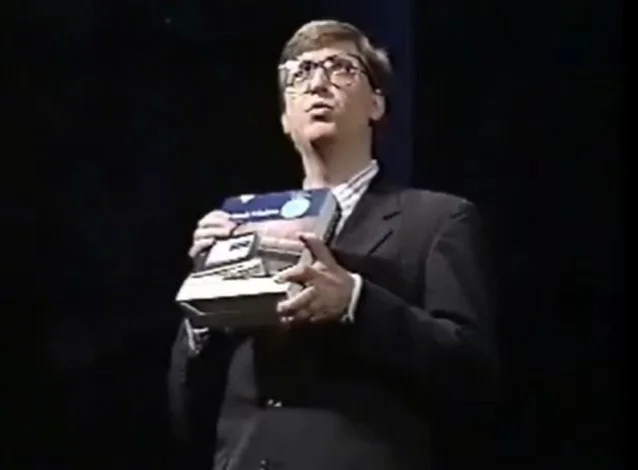
IBM and Compaq both refused to pre-install it. 3 IBM had co-developed OS/2 with Microsoft since 1985 and was still publicly presenting it as the industry's inevitable successor to MS-DOS. 4 Even two days before the Windows 3.0 launch, industry trade press treated OS/2 as the foregone conclusion. 1 Within months, that framing collapsed. Microsoft shifted all development focus to Windows; IBM took full ownership of OS/2 and eventually recorded what was at the time the largest single-year loss in U.S. corporate history, in part attributable to OS/2's commercial failure. 4 Microsoft's revenue crossed $1.18 billion in fiscal year 1990 — the first PC software company to clear $1 billion in a year — and reached $5.94 billion by fiscal year 1995. 2
Mirror: The Windows 3.0 story is often told as a triumph of marketing. It was also a lesson in coalition-building before launch. Microsoft secured 30+ OEM commitments before the announcement; IBM and Compaq's refusal barely registered because the market had already moved. If you're defending a platform, the question isn't whether the challenger is technically ready — it's how many distribution agreements they already have.
May 22, 2018 — NYSE names its first female president in 226 years
Stacey Cunningham (then 43) was named the 67th president of the New York Stock Exchange, the first woman in the exchange's 226-year history to hold full leadership authority. 5 Her title was President of NYSE Group — not CEO, a distinction that NPR corrected the same day it misreported the appointment. 6
She came up through the floor. In 1994, at 19, Cunningham interned on the trading floor when roughly 30 women worked among 1,000 men. 5 She joined full-time in 1996, spent eight years as a floor specialist, left in 2005 frustrated by NYSE's slow technology transition, briefly attended culinary school, worked at Nasdaq from 2007 to 2011, and returned to NYSE in 2012 — shortly before ICE (Intercontinental Exchange, which acquired NYSE Euronext for $8.2 billion that year) completed its takeover. 7 She became COO in 2015 and stepped up to president in 2018.

At the same time, Nasdaq CEO Adena Friedman — who had taken the role in January 2017 — remained in post, marking the first time both major U.S. exchanges were simultaneously led by women. 5 Former NYSE CEO Dick Grasso said Cunningham "was born to run the New York Stock Exchange." 9 Cunningham told NBC: "I do look forward to a day when a woman taking a job isn't newsworthy. But we aren't quite there yet." 5
Her tenure ended in December 2021. During it, she ordered the first all-electronic closure of the trading floor in the exchange's 228-year history (March 23, 2020, for COVID-19) and oversaw what became the two largest U.S. IPO years on record — though NYSE lost IPO market share to Nasdaq in all three of her full years, and its share of U.S. equity volume fell from 24% in 2019 to 19% in 2021. 10 11 She was succeeded by Lynn Martin, another woman, meaning the appointment's structural effect outlasted her individual tenure.
Mirror: Cunningham spent eight years away from NYSE — including a stint in culinary school — and came back to eventually lead it. Institutions that look impenetrably male-dominated often have individual career paths that are more open than the aggregate statistics suggest. The question for talent strategy: are you treating the pipeline as fixed, or are you actively creating the re-entry conditions for the people who left?
May 22, 2012 — SpaceX launches the first commercial cargo flight to the ISS
At 3:44 AM EDT, a Falcon 9 rocket lifted off from Cape Canaveral's SLC-40 in the first night launch of the vehicle's career, carrying Dragon capsule C102. 12 Thirteen minutes later, the solar arrays deployed. Elon Musk posted: "Falcon flew perfectly!! Dragon in orbit, comm locked and solar arrays active!! Feels like a giant weight just came off my back." 12
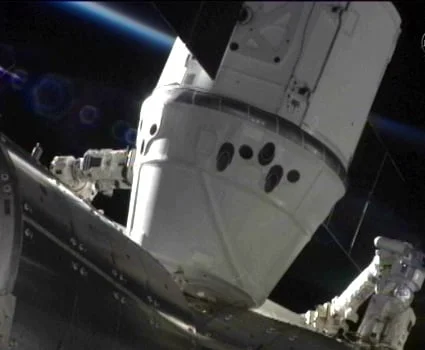
Three days later, on May 25, NASA astronaut Don Pettit captured Dragon with the ISS's Canadarm2 robotic arm: "Looks like we got us a Dragon by the tail." 13 The capsule delivered 525 kg of cargo and returned 665 kg on May 31. 14 It was the first commercial spacecraft to berth with the ISS and the first U.S. vehicle to visit since the Space Shuttle's retirement in 2011.
This mission was the product of a 2006 NASA procurement experiment. Rather than award a cost-plus contract in the usual way, the agency used Space Act Agreements: milestone-based payments, shared development costs, and no specification of how the vehicle had to be built. 15 SpaceX received $278 million in COTS funding. 16
The numbers are stark. NASA analyst Harry Jones estimated the Space Shuttle's payload cost at roughly $54,500 per kilogram; Falcon 9 brought that to approximately $2,720 per kilogram. 17 By May 2020, Crew Dragon carried the first NASA astronauts launched commercially from U.S. soil since the Shuttle's retirement. 18 Boeing's Starliner, by contrast, won a $4.2 billion fixed-price contract in 2014 — 60% more than SpaceX's $2.6 billion award — accumulated more than $2 billion in losses, and had its first operational crewed flight pushed to no earlier than 2027. 18
Mirror: The COTS program worked because NASA changed the contract structure before changing the supplier. Milestone-based agreements aligned incentives in a way cost-plus never could. If you're trying to get a new supplier or internal team to move fast, the question worth asking isn't "do we trust them enough?" — it's "does the contract structure give them a reason to move fast, or a reason to be cautious?"
Cover image: Falcon 9 / Dragon C102 night launch, May 22, 2012. NASA TV (public domain).
References
- 1Hardcore Software: Windows 3.0 Buzz
- 2Microsoft Learn: The History of Microsoft – 1990
- 3Motley Fool: Microsoft Seizes Control of the Computer Industry
- 4Wikipedia: OS/2
- 5NBC News: New York Stock Exchange gets its first female president
- 6NPR: A Woman Has Been Named As NYSE President. It Only Took 226 Years
- 7Wikipedia: Stacey Cunningham
- 8The Guardian: Stacey Cunningham, the NYSE's first female president
- 9CNBC: Stacey Cunningham was born to run the NYSE
- 10New York Post: NYSE reveals Stacey Cunningham stepping down
- 11CNBC: NYSE shakes up senior management
- 12Space.com: SpaceX Launches Private Capsule on Historic Trip to Space Station
- 13Wikipedia: SpaceX COTS Demo Flight 2
- 14Wikipedia: SpaceX Dragon 1
- 15Center for Growth and Opportunity: A 2006 NASA program shows how government can move at the speed of startups
- 16Wikipedia: Commercial Resupply Services
- 17Inverse: 10 years ago, one SpaceX launch showed NASA they could work with Elon Musk
- 18The Planetary Society: NASA's Commercial Crew Program is a Fantastic Deal
Add more perspectives or context around this Drop.