
Hoover Dam: how engineers tamed the Colorado — and what they hid for nine years

Hoover Dam: how engineers tamed the Colorado — and what they hid for nine years

A technically grounded case study of Hoover Dam (1931–1936): how arch-gravity structural design saved 1.5 million cubic yards of concrete, how 582 miles of embedded cooling pipe and a 1,000-ton/day refrigeration plant solved the heat-of-hydration problem in 3.25 million cubic yards of mass concrete, and how 58 of 393 foundation grout holes were left incomplete under schedule pressure — triggering a nine-year secret remediation (1938–1947) not publicly acknowledged for decades.

Engineering Marvel Teardown
May 23, 2026 · 12:13 AM
3 subscriptions · 5 items
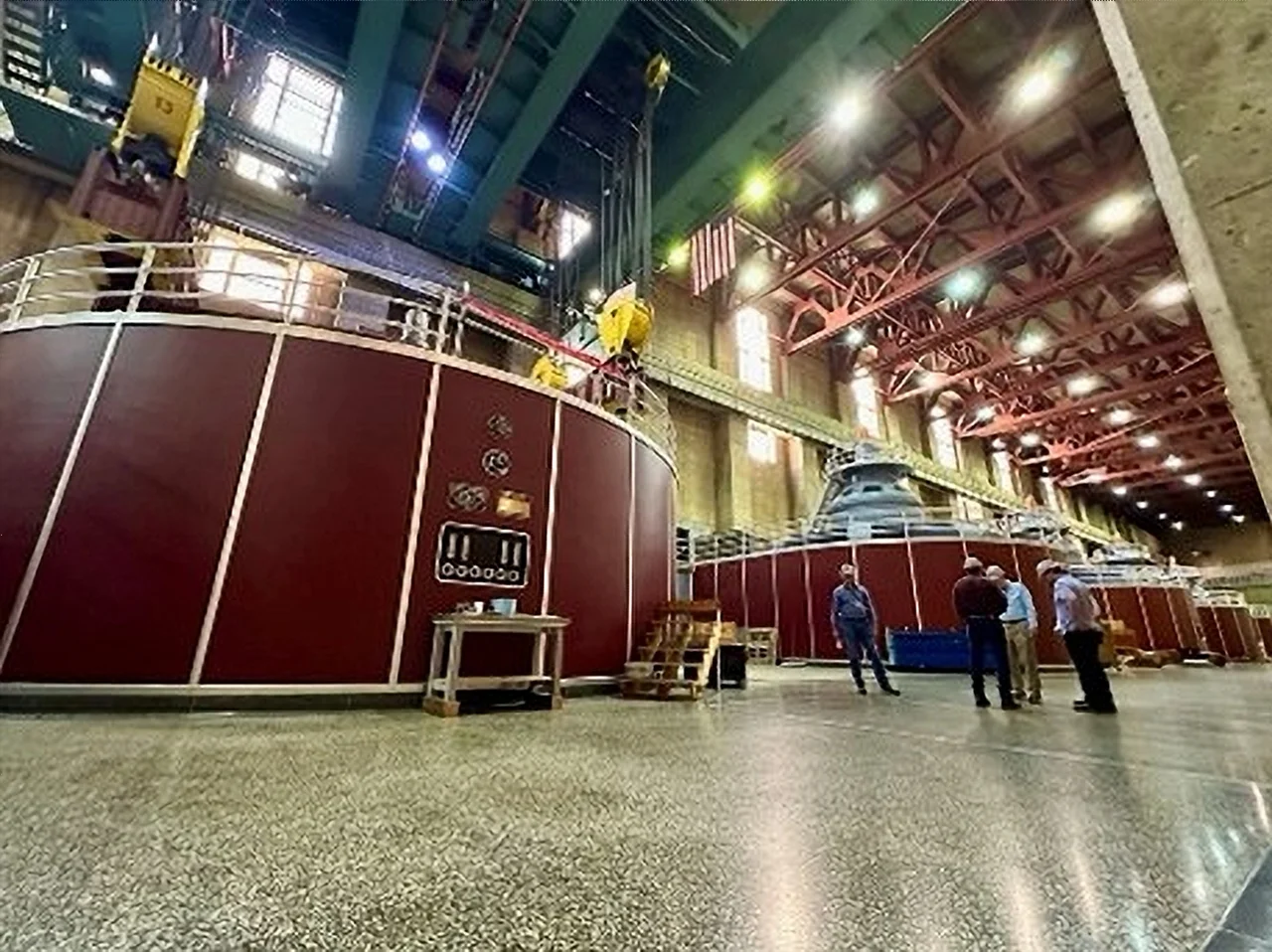
Interior of Hoover Dam's powerhouse showing rows of large generator units and four workers on the floor beneath a steel-frame ceiling
Inside Hoover Dam's powerhouse, 2026. 1
In the summer of 1931, at the bottom of a Nevada canyon so narrow that sunlight only reached the riverbed a few hours a day, twenty thousand men and three shifts of machinery began one of the most technically demanding construction projects the United States had ever attempted. The Colorado River — which had torn through the Grand Canyon and flooded the Imperial Valley on its own irregular schedule for centuries — was about to be stopped.
What the engineers built in five years still stands at 726.4 ft (221.4 m) of arch-gravity concrete, generating power for 1.3 million people at peak capacity and holding back a reservoir that stretches 112 miles into the desert. 2 What they concealed for the nine years after completion, and kept from public record for five more decades after that, is the part of the story that matters most to anyone trying to understand what large-scale infrastructure engineering actually looks like in practice.
Loading link preview…

The brief: flood control, water rights, and a depression-era labor crisis

The Colorado River had been flooding the Salton Sink in southern California since 1905, when an irrigation company's diversion canal failed and the river flowed unchecked for 18 months, creating a 35-mile inland lake. By 1922, the seven states sharing the river had negotiated the Colorado River Compact, dividing the river's flow between upper and lower basin states — but the compact assumed a long-term average annual flow of 17.5 million acre-feet, a figure that turned out to be significantly higher than the 20th-century average of roughly 14.8 million acre-feet. 2
The Bureau of Reclamation (USBR), established in 1902 to manage irrigation infrastructure in the American West, received congressional authorization for a dam in 1928 under the Boulder Canyon Project Act. The four mandates in the act were specific: control seasonal flooding, store water for lower-basin states, supply irrigation water to California's Imperial Valley, and generate electricity to repay construction costs. 2
President Hoover signed the project into law in June 1929. By the time construction contracts were awarded in 1931, the Great Depression had reduced unemployment to catastrophic levels. The dam was no longer just a water management project — it was a federal jobs program, and the political pressure to start work, hire workers, and show visible progress was as real a design constraint as the geology of Black Canyon.

Structural form: why arch-gravity

The choice to build an arch-gravity dam rather than a pure gravity dam was not obvious in 1930, and the decision carries real engineering content.
A gravity dam resists the hydrostatic pressure of the reservoir purely by its own weight — the concrete mass is large enough that the overturning moment from water pressure cannot tip it. It requires no load transfer to the canyon walls, which means it works on flat-bottomed valleys with weak or variable abutments. The tradeoff is concrete volume: for a dam of Hoover's height, a pure gravity design would require a substantially wider base — the base-to-height ratio for a gravity dam is typically 0.7–0.8 times the dam height, meaning a base width approaching 500–580 ft would have been required at the 726-ft height.
An arch-gravity dam transfers a portion of the water pressure laterally into the canyon walls through horizontal arch action, allowing a thinner cross-section. At Hoover Dam, the base width is 660 ft (201 m) against a height of 726.4 ft — but the horizontal curvature allows significant reduction in the required cross-sectional area compared to a gravity design at the same height, because the arch ribs carry part of the load to the abutments. 2
The canyon geometry at Black Canyon (the final site, moved from the originally surveyed Boulder Canyon because Black Canyon's rock was stronger and the canyon narrower) suited arch action: the granite and andesite walls provide strong, continuous abutment bearing surfaces. USBR engineers under John L. Savage, the bureau's chief design engineer, calculated that the horizontal radius of curvature at the crest would allow the arch component to carry a substantial fraction of the horizontal water load into the canyon walls, with the gravity component carrying the remainder.
The arch-gravity form saved an estimated 1.5 million cubic yards of concrete compared to a gravity-only design at the same height. 2 It also meant that the structural integrity of the dam depends partly on the abutment rock — which is exactly why the grout curtain beneath the foundation would matter so much two years after completion.

The hardest problem: heat of hydration in 3.25 million cubic yards of concrete

Mass concrete chemistry poses a problem that no amount of engineering ambition can simply overrule: when Portland cement hydrates, the reaction is exothermic, and in a large mass, the heat cannot dissipate fast enough to prevent thermal gradients. Those gradients produce differential expansion and contraction — which produces cracking. A monolithic pour of the volume required for Hoover Dam — 3.25 million cubic yards (2.49 million m³) — would, according to USBR calculations, have taken approximately 125 years to cool to ambient temperature if poured as a single mass. 2
At the peak temperature differential the interior of a monolithic pour would have reached, the tensile stresses from differential shrinkage would have exceeded the tensile strength of the concrete by a factor of several times. The dam would have cracked — not catastrophically at first, but in ways that would progressively compromise its impermeability and structural integrity.
The USBR's solution was to abandon the monolithic pour concept entirely and replace it with a column-pour system and an embedded cooling pipe network.

Column-pour method

The dam was divided into roughly 215 interlocking vertical columns, each approximately 5 ft × 12 ft in plan, with each concrete lift within a column limited to 5 ft (1.5 m) in height. 2 Before the next lift was placed, the previous one had to cool to near-ambient temperature. The column geometry allowed each individual pour to be small enough that natural heat dissipation was manageable, and the interlocking plan geometry meant the columns would eventually be grouted together into a monolithic structure.

582 miles of cooling pipe

Natural cooling from the column geometry was still too slow to maintain construction pace. The USBR embedded a 582-mile (937 km) network of 1-inch-diameter steel pipe directly into the concrete as it was placed. 2 Chilled water — cooled by a refrigeration plant — circulated through these pipes and carried heat out of the concrete mass. The pipes were left in place after the concrete reached the desired temperature and were subsequently pressure-grouted to fill the void.
To generate enough chilled water, the USBR built a 1,000-ton-per-day refrigeration plant — the largest in the Western Hemisphere at the time of construction. 2 It ran continuously for the full construction period. Without it, the column-pour method would have been too slow to meet the project schedule; with it, the average column cooled to grout temperature in roughly 14 days per 5-ft lift.
After all columns had reached ambient temperature, USBR crews drilled holes between adjacent columns and pressure-injected cement grout under controlled conditions, bonding the columns into the monolithic structure the original design required. This grouting sequence — cool first, grout second — is now standard practice for mass concrete dams worldwide.

Trade-off decisions documented in the engineering record

Several major decisions in the project involved explicit choices between competing approaches. The arch-gravity vs. gravity-only choice has been covered above. Three others are worth noting:
Site selection: Black Canyon vs. Boulder Canyon. The Boulder Canyon Project Act authorized construction at Boulder Canyon by name, but USBR survey parties spent two years drilling core samples in both locations before recommending Black Canyon. 2 The decision turned on abutment rock quality — the granitic and andesitic formations at Black Canyon were structurally superior to the fractured diorite at Boulder Canyon — and on the fact that Black Canyon's narrower width reduced the required crest length, cutting concrete volume. Congress accepted the relocation without amending the act, which is why the dam is named "Hoover" rather than "Boulder" in official usage (the name "Boulder" was assigned to the city constructed to house workers).
Penstock routing: embedded vs. external. The four intake towers that draw water from Lake Mead feed it through 30-ft-diameter (9.1 m) steel penstocks to the turbines in the powerhouse at the base of the dam. 2 The design decision was to embed these penstocks partially within the concrete of the dam rather than routing them externally. Embedding reduced the unsupported pipe length subject to hydrostatic pressure, allowed the dam structure itself to provide radial confinement, and protected the steel from external corrosion. The tradeoff was that any future maintenance requiring penstock access would require cutting through dam concrete — an intervention that has not yet been necessary after 90 years.
Powerhouse geometry: twin wing vs. single. Rather than building a single powerhouse on one side of the canyon, the USBR split the generating equipment into two powerhouses — one in Nevada, one in Arizona — built into the canyon walls at the base of the dam. This gave each state visible physical evidence of the power generation infrastructure assigned to it under the Colorado River Compact, and it reduced the required span of individual powerhouse bays, making crane installation simpler. Electrically, the outputs are combined before transmission; the split had no engineering disadvantage. 2

Technical specifications

ParameterValue
Height726.4 ft (221.4 m)
Crest length1,244 ft (379 m)
Base thickness660 ft (201 m)
Crest thickness45 ft (13.7 m)
Concrete volume3.25 million cu yd (2.49 million m³)
Structural steel45 million lb (20,400 t)
Cooling pipe network582 miles (937 km)
Refrigeration plant capacity1,000 tons/day
Penstock diameter30 ft (9.1 m)
Nameplate generating capacity2,080 MW (17 turbine units)
Lake Mead storage capacity28.5 million acre-ft (35.2 km³)
Spillway capacity (combined)400,000 cfs (11,328 m³/s)
Construction cost$49 million (1931 dollars)
Construction period1931–1935 (dedicated September 1935; turbines commissioned 1936)
Sources: 2 1

Construction process: Six Companies and five years in a canyon

The USBR solicited bids in 1931 with specifications so demanding that no single contractor in the United States had the combined bonding capacity, equipment inventory, and experience to bid alone. Six of the largest contractors in the country — including Henry Kaiser's operations and Morrison-Knudsen of Boise — formed a joint venture called Six Companies Inc., which submitted the winning bid of $48,890,955 — the lowest of three bids received. 2
Before a single cubic yard of concrete could be poured, the contractors had to divert the entire Colorado River. They drilled four diversion tunnels through the canyon walls — each 56 ft (17 m) in diameter and collectively running more than three miles — and lined them with concrete. 2 In November 1932, cofferdams upstream and downstream of the dam site forced the river into the tunnels, leaving the Black Canyon floor dry for the first time in geologic history.
High-scalers — workers suspended on rope stages from the canyon rim, using jackhammers and pry bars — stripped loose and fractured rock from the canyon walls to reach competent bearing surfaces. At peak, crews were stripping both walls simultaneously, with high-scalers working at heights over 700 ft above the canyon floor. The job was continuous, physically extreme, and performed without any modern fall-arrest equipment.
Workforce numbers peaked on July 1, 1934, when 5,251 workers were on-site simultaneously. 2 The contractors built an entire city — Boulder City, Nevada — from scratch to house, feed, and manage the workforce, with infrastructure for 5,000 residents including a hospital, schools, and a sewage treatment plant. Workers from across the lower-48 states, many unemployed for years before arriving, worked three eight-hour shifts, seven days a week.

112 official deaths and the heat prostration dispute

The USBR and Six Companies recorded 112 deaths classified as industrial accidents during construction. 3 This figure excludes deaths classified as illness — specifically, heat-related illness.
The controversy involves the category of "heat prostration," which USBR medical records show claimed the lives of dozens of workers during the summer months when canyon temperatures regularly exceeded 130°F at the floor where concrete was being poured. 3 Six Companies classified these deaths as non-industrial because they allegedly occurred off-site or were attributed to pre-existing conditions. Multiple subsequent analyses acknowledged that the 112 figure understates total construction mortality if heat prostration fatalities are included; estimates of the true toll range from 112 to over 200. The workers' families received no compensation for deaths in the excluded category.
The dam was dedicated on September 30, 1935, by President Franklin D. Roosevelt — two years ahead of the original schedule. Power generation began in September 1936 after the turbines were commissioned. 2

The grout curtain: nine years of silence

Loading link preview…
This is the part of the Hoover Dam story that was not publicly acknowledged for decades after construction.

The purpose of a grout curtain

An arch-gravity dam transfers its loads to the foundation rock and canyon walls, but the foundation rock itself is not monolithic. Natural rock contains fractures, joints, and permeable zones through which pressurized reservoir water can migrate. If that migration reaches the downstream toe of the dam at sufficient pressure, it reduces the effective weight of the dam by hydraulic uplift: the same water pressure that the dam is built to resist can work its way under the foundation and partly negate the gravity component of the design.
To prevent this, dam engineers inject pressurized cement grout into the foundation rock through a grid of drilled holes before and during reservoir filling. The grout seals the fractures and creates an impermeable zone — the grout curtain — that limits underseepage. At Hoover Dam, holes were driven into the walls and base of the canyon as deep as 150 ft (46 m) into the rock before construction of the dam body began. 2

What happened between 1938 and 1947

The grouting work was conducted under severe time pressure — the construction schedule for the concrete pour was fixed, and when workers encountered hot springs or cavities too large to readily fill, they moved on without resolving the problem. Of the 393 grout holes drilled, 58 were incompletely filled. 2
After the dam was completed and the reservoir began to fill, significant leaks appeared at the downstream face — evidence that the original curtain had not adequately sealed the foundation rock, and that hydraulic uplift pressures beneath the foundation were higher than the design assumed. The USBR examined the situation, found that the work had been incompletely done and based on less than a full understanding of the canyon's geology, and made a decision: fix it, but do not disclose it publicly.
New holes were drilled from inspection galleries inside the dam into the surrounding bedrock. It took nine years — 1938 to 1947 — under relative secrecy to complete the supplemental grout curtain. 2 The remediation campaign was logged in internal USBR engineering reports, but those reports were not shared with Congress, the public, or the dam's electricity customers for decades after the work was finished.

The delayed acknowledgment and its consequences

The grout curtain remediation became part of the public record only in later USBR historical documentation and academic dam-safety literature — not through contemporaneous disclosure. The engineering community's formal reckoning with the precedent came in the aftermath of the 1976 Teton Dam collapse, in which a piping failure through inadequately grouted foundation soils caused the sudden failure of a 305-ft earthen dam in Idaho, killing 11 people and causing $2 billion in damage. 2 The Teton failure drove a comprehensive overhaul of USBR dam safety standards and foundation monitoring requirements.
The grout curtain episode's engineering legacy is procedural rather than structural. Post-Teton USBR dam safety standards require continuous foundation drainage monitoring, automatic reporting thresholds for seepage above specified flow rates, and disclosure requirements that prevent a repeat of the 1938–1947 suppression pattern. The specific disclosure requirements are a direct institutional response to the precedent — what the engineers who ran the remediation campaign did was technically adequate but institutionally unacceptable, and the revised standards exist to ensure it cannot recur at any USBR facility.

Legacy: what Hoover Dam changed in dam engineering

The column-pour method becomes standard practice

Before Hoover Dam, there was no established solution to heat-of-hydration cracking in mass concrete at scale. The USBR's combination of column-pour geometry, embedded cooling pipes, chilled water circulation, and post-cooling column grouting — developed specifically for this project — was adopted as standard practice for subsequent large dam projects. Glen Canyon Dam (1966), Shasta Dam (1945), and Grand Coulee Dam (1942) all used variants of the Hoover Dam concrete management procedures. 2 The USBR published its concrete cooling specifications in 1940, and those specifications became the reference standard for the American Concrete Institute's mass concrete guidance.

Arch-gravity form validated at scale

Arch-gravity dams had been built before Hoover — Gibson Dam in Montana (1929) and Owyhee Dam in Oregon (1932) both used arch-gravity geometry — but none at the scale required to validate the form for large canyon-site applications under high hydrostatic head. Hoover Dam's performance under the 726-ft head established the structural case for arch-gravity design at large scale, and the form was subsequently used at Parker Dam (1938) on the Colorado River, Shasta Dam on the Sacramento River, and dozens of international projects where canyon geometry and abutment quality permitted. 2
The arch component's efficiency — the ability to transfer load laterally and reduce required concrete volume — is the reason arch-gravity became the preferred form for canyon-sited dams globally in the second half of the 20th century. Every time an engineer reaches for an arch-gravity design at a narrow canyon site, the validation data begins at Black Canyon, 1936.

Modern context: Lake Mead at record lows and the 2026 turbine upgrade

The Colorado River's long-term average annual flow is now estimated at approximately 12–14 million acre-feet, substantially below the 17.5 million acre-feet assumed in the 1922 Compact. 2 Prolonged drought in the Colorado Basin, combined with water demand from the 40 million people and 4 million acres of irrigated farmland in the lower basin, has drawn Lake Mead down from its full-pool elevation of 1,229 ft to a record low of approximately 1,040 ft in July 2022 — roughly 24% of the reservoir's 28.5 million acre-foot capacity. 1
Loading chart…
Lake Mead water surface elevation, 2000–2024. The dam's original turbines carry serious cavitation risk below ~1,035 ft elevation; the 2022 record low of ~1,040 ft brought generation to crisis conditions.
The hydrostatic head available to the turbines — the vertical distance between the reservoir surface and the turbine centerline — drops as the lake level falls. The dam's 17 generating units were rated for a combined nameplate capacity of 2,080 MW at design head. 2 By 2022–2023, the derated operating capacity had fallen to approximately 1,592 MW — a reduction of roughly 23% from the nameplate — as available head declined with the reservoir. 1
The deeper operational risk emerged from cavitation. At reservoir elevations below approximately 1,035 ft, the old turbine runners — many of them Francis-type units installed between 1936 and 1961 — face vapor bubble formation and implosion damage severe enough to destroy the runner surfaces within months. A USBR technical review concluded that under the original turbine configuration, worst-case reservoir conditions could reduce total generating capacity to approximately 382 MW — 18% of nameplate. 1

The 2026 upgrade: wide-head turbines and repurposed retirement funds

In May 2026, USBR announced a $52 million turbine replacement program funded from the Hoover Dam Post Retirement Benefit Fund — an account originally collected from electricity customers by the Western Area Power Administration (WAPA) to cover post-retirement benefits for Hoover Dam employees. When Hoover Dam workers were folded into the federal retirement system in the early 2000s, the original fund purpose became moot; WAPA redirected the accumulated balance to capital maintenance. 1
The program replaces up to 3 of the old turbine runners with wide-head turbine designs engineered to operate without significant cavitation damage at reservoir elevations as low as 950 ft — 85 ft below the damage threshold of the original units. 1 The replacement is projected to restore at least 160 MW of generating capacity that would otherwise be unattainable at low reservoir levels.
Andrea Travnicek, the U.S. Assistant Secretary for Water and Science, described the rationale: "This project is about protecting long-term energy reliability for the Southwest. These upgrades will ensure Hoover Dam remains a cornerstone of American energy production for decades to come." 1
The turbine upgrade addresses one stress vector — low-head cavitation — but does not resolve the underlying hydrology. Even with wide-head turbines, a reservoir at 950 ft holds approximately 4–5 million acre-feet, roughly 15–18% of design capacity. Whether the Colorado Basin receives sufficient precipitation to restore Lake Mead to levels adequate for the dam's original power mandate is a question that turbine metallurgy cannot answer.

What the dam actually demonstrates

Loading stats card…
The Hoover Dam case is sometimes presented as proof that Depression-era American engineering could accomplish anything it set out to do. The record is more specific than that.
The structural design was correct. The arch-gravity form has stood under 90 years of hydrostatic loading without any indication of structural distress. The column-pour and cooling pipe system worked exactly as designed and produced concrete that subsequent core drilling has shown to be sound. Six Companies built the dam two years ahead of schedule.
The grout curtain was not fully adequate on first installation. Of 393 grout holes drilled into the foundation rock, 58 were incompletely filled under schedule pressure; significant leaks appeared within two years of reservoir filling; and the supplemental remediation program ran for nine years under relative secrecy before the problem was resolved. 2 The engineering response to the failure was competent: new holes drilled from inspection galleries inside the dam were an appropriate technical remedy. The institutional decision to suppress that information from public record for decades was not a technical decision. It was a governance choice, and the post-Teton dam safety reforms exist because the engineering community eventually agreed it was the wrong one.
Both of these facts are true simultaneously: the dam's structural body performed; its foundation seal did not, initially, and the institutions responsible for it chose to fix it quietly rather than acknowledge it openly. In 2026, Lake Mead sits at roughly 35% of its design capacity, the generating units are running at 77% of nameplate, and a $52 million upgrade is underway to equip three turbines for conditions the original 1930s design never anticipated. The structure itself shows no signs of stress. The constraints bearing down on it are hydrological, not mechanical. The limiting factor for what Hoover Dam can do in the next century has already left the hands of the engineers who built it.

Cover image: Hoover Dam powerhouse interior, 2026. Image from Hoover Dam gets $52 million upgrade — Western Water

Add more perspectives or context around this Drop.

  • Sign in to comment.